Cloud RKI vs On-Premises RKI: What Should Banks Really Consider?
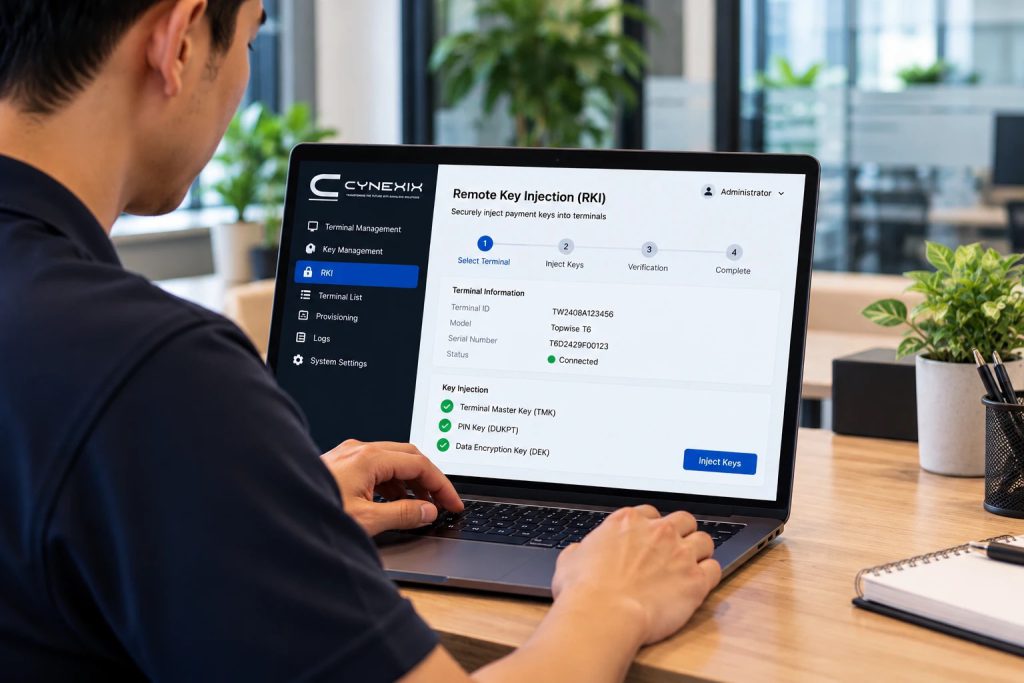
Loading cryptographic keys into one payment terminal takes minutes in a secure room. Now do it five thousand times, across several markets, every time a key rotates. That is the problem Remote Key Injection (RKI) was built to solve. Instead of physically loading keys into every terminal, banks and payment providers can securely provision them remotely.
And once a bank decides to adopt RKI, the next question arrives immediately: should it live in the cloud, or in the bank’s own data center?
At first, this may look like a simple technology decision. In reality, it is much more about security, control, responsibility, and long-term operations.
Cloud or On-Premises: Is One More Secure?
A well-designed cloud RKI environment can provide strong security, high availability, centralized management, and easier scalability. At the same time, an on-premises solution can give a bank greater control over its infrastructure, HSMs, access policies, and operational processes.
The important point is that where the RKI is hosted does not automatically determine how secure it is.
The real question is how the entire environment is designed and operated.
For example, banks should understand where cryptographic keys are generated, where they are stored, how HSMs are managed, who can access the system, and how key operations are monitored and audited.
The Cloud Approach
Cloud RKI can be attractive for banks that want to reduce the amount of infrastructure they need to operate themselves.
Instead of building and maintaining the complete RKI environment internally, a bank can work with an RKI service provider that manages part or all of the infrastructure.
This can make deployment faster and scaling easier, particularly when the number of payment terminals is growing rapidly.
It can also reduce the operational burden of maintaining servers, monitoring infrastructure, managing availability, and supporting the platform.
But there is an important consideration: shared responsibility.
Even when the infrastructure is operated by a service provider, the bank still needs to understand and control its security requirements. Who manages the HSM? Who has administrative access? How are keys protected? What happens if the service becomes unavailable?
These questions should be answered before selecting a cloud RKI solution.
The On-Premises Approach
On-premises RKI takes the opposite approach.
The bank operates the RKI environment within its own infrastructure and generally has more direct control over the servers, HSMs, network, access controls, monitoring, and operational procedures.
For organizations with strong internal security and infrastructure teams, this can be an attractive model.
However, greater control also means greater responsibility.
The bank becomes responsible for keeping the environment available, secure, monitored, patched, backed up, and ready for disaster recovery.
As the payment-terminal estate grows, the bank must also make sure that its RKI infrastructure can handle additional terminals, key-injection requests, and new payment applications.
Security, Reliability, and Room to Grow
Choosing an RKI solution is about more than where it is hosted. It is about protecting keys, keeping payment operations running, and preparing for future growth.
The HSM sits at the heart of key security. Strong key-management procedures, controlled access, dual control, split knowledge, and proper auditing help protect cryptographic keys throughout their lifecycle. Whether cloud-based or on-premises, the security of an RKI solution ultimately depends on how well it is designed and managed.
But security alone is not enough. When a key injection fails or an RKI service becomes unavailable, payment-terminal deployment can be delayed. Banks need reliable operations, effective monitoring, and clear responsibility for resolving issues.
As payment businesses expand, RKI must also keep pace with more terminals, new device models, and evolving payment requirements. Cloud solutions may simplify scaling, while on-premises deployments can offer greater direct control.
The real goal is to choose an RKI solution that protects today’s payments without limiting tomorrow’s growth.
So, Which One Should a Bank Choose?
The answer depends on the bank.
A bank with strong internal infrastructure and security capabilities may prefer the control of an on-premises environment.
Another bank may prefer a cloud-based RKI service because it wants faster deployment, easier scalability, and less infrastructure to manage internally.
The most important thing is to look beyond the words “cloud” and “on-premises.”
Before making a decision, banks should ask:
Who owns the infrastructure? Who controls the HSM? Who protects the keys? Who monitors the environment? Who responds to incidents? Who is responsible for availability? And ultimately, who is accountable?
These questions are often more important than where the RKI server is physically located.
So, here are my final thoughts:
Cloud RKI and On-Premises RKI are both viable approaches for modern payment environments.
The right choice is not necessarily the technology that offers the most features. It is the solution that fits the bank’s security strategy, operational capabilities, compliance requirements, scalability needs, and long-term business objectives.
For banks, the decision should therefore go beyond “Cloud or On-Premises?”
The better question is:
“Which RKI operating model gives us the right balance of security, control, responsibility, and scalability?”
That is where the real decision begins.
About the Author